
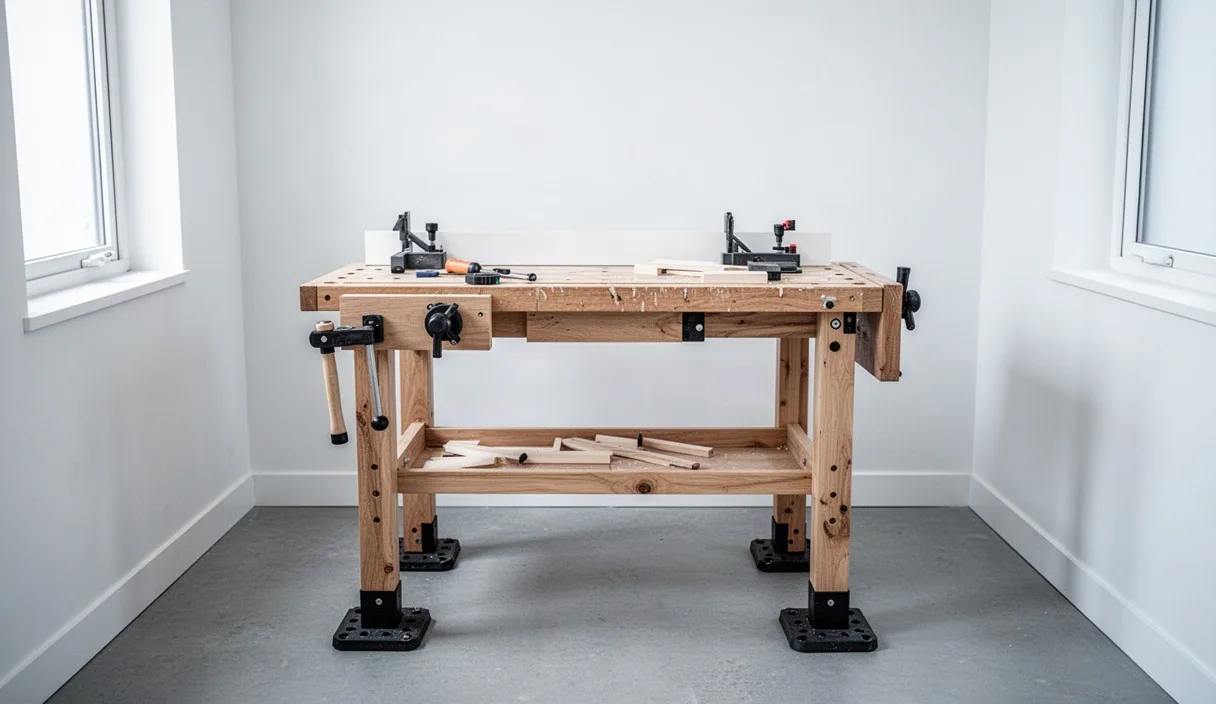

Making things inside an apartment brings a specific kind of tension. You want to shape wood, trim metal, or assemble furniture, but you live above, below, and beside other people. Most power tools are built for open garages or detached job sites where nobody worries about high-pitched motor screams or the deep rumble traveling through concrete floors. When you squeeze those same tools into a spare room or a corner of your living room, every cut feels like a social risk.
Operating a workshop in a multi-family building does not mean giving up on projects. It means choosing your gear and arranging your space around the physics of sound. By understanding how noise travels through the air and through the physical frame of your building, you can choose machines that stay quiet, damp down the vibrations you cannot prevent, and build an environment where making things does not ruin your relationship with your neighbors.
Airborne Noise versus Structure-Borne Vibration
Why does a router sound mildly annoying in your room, but make your downstairs neighbor feel like their ceiling is caving in? The answer lies in the two ways sound moves through a building. Airborne noise consists of pressure waves traveling through the open air. This is the whining tone of a motor spinning at twenty thousand revolutions per minute or the rasp of a blade tearing through plywood. Airborne sound slips under door frames, passes through thin drywall, and escapes through HVAC ducts. You can often lower it by sealing air gaps, hanging heavy blankets, or simply closing the interior doors.
Structure-borne noise, on the other hand, is mechanical vibration that directly enters the building structure. Think of a child bouncing a basketball on a hardwood floor. The bounce makes an audible tap in the room, but through the floorboards and joists below, it turns into a heavy, thudding boom. When a power tool rests directly on a table, and that table rests on the floor, the tool vibrates the table, the table vibrates the subfloor, and the entire floor structure acts like a giant speaker diaphragm. Structure-borne vibration carries much farther than airborne noise and is nearly impossible for neighbors to tune out.
To control sound in an apartment, you must diagnose which type you are creating. If you drop a wrench on your bench and hear a sharp ping in your ears, that is airborne sound. If you lean your hand against the adjacent wall and feel a rhythmic hum while a sander runs, you are dealing with structure-borne vibration. Power tools generate both simultaneously. Your goal is to lower airborne volume at the tool level and stop structure-borne energy from ever touching your floorboards.
Universal Motors versus Brushless Induction Motors
What makes one motor scream while another hums quietly? Most budget power tools, like standard circular saws, job-site table saws, and inexpensive palm routers, rely on universal motors. A universal motor uses carbon brushes that press physically against a spinning commutator to transfer electrical current. This direct friction, paired with very high operating speeds, generates an intense, high-pitched mechanical whine even when the tool is spinning freely without touching any wood. When people describe a tool as sounding like a screaming jet engine, they are describing a universal motor spinning at high speed.
Induction motors and modern brushless direct-current motors operate on a completely different principle. An induction motor uses an electromagnetic field to spin the rotor without physical brushes scraping against metal contacts. Because there are no brushes to create friction, and because induction motors typically run at lower rotational speeds like seventeen hundred or thirty-four hundred revolutions per minute, they produce a low, quiet hum instead of a shriek. You can hold a normal conversation directly next to an active induction-motor bandsaw, whereas a universal-motor miter saw demands hearing protection.
Brushless motors in modern cordless tools bridge these two worlds. They eliminate the physical brushes and rely on electronic controllers to deliver power. While they still rotate quickly, they run noticeably quieter than brushed tools, run cooler, and lack the harsh electrical crackle of carbon brushes dragging across copper. When choosing tools for a small living space, checking the motor type will tell you more about its operating volume than reading marketing claims on the box.
| Motor Type | Mechanical Contact | Typical Sound Profile | Common Tool Applications |
|---|---|---|---|
| Universal (Brushed) | Carbon brushes riding on a spinning commutator | High-pitched whine, often eighty-eight to ninety-five decibels free-spinning | Job-site table saws, trim routers, cheap miter saws |
| Brushless DC | Electronic switching, no physical brush contact | Mid-range hum, generally seventy-two to eighty decibels free-spinning | Cordless drills, cordless jigsaws, high-end palm sanders |
| Induction | Magnetic fields only, no contact components | Deep, quiet hum, usually under sixty-five decibels free-spinning | Stationary drill presses, cast-iron band saws, floor lathes |
Decoupling Benches with Heavy Mats and Rubber Feet
How do you prevent your workbench from turning into an amplifier for your tools? You isolate it using a method known as mechanical decoupling. Decoupling means breaking the direct physical link between vibrating objects so energy cannot pass between them. If you place a running orbital sander on a bare pine table resting on a wood floor, the energy flows straight down into the ceiling of the unit below you. Breaking that chain requires two things: substantial mass to absorb energy and compliant material to isolate it.
The first line of defense is heavy rubber. Stall mats made of vulcanized rubber, typically used for horse stalls or weight rooms, are ideal for apartment shops. A standard three-quarter-inch thick stall mat weighs roughly sixty pounds. That dense, flexible mass absorbs mechanical shock instead of reflecting it. Laying a mat beneath your workbench creates an immediate barrier against floor transmission. For small benchtop tools like scroll saws or benchtop drill presses, you can cut smaller sections of stall mat to sit directly beneath the tool bases.
To isolate your workspace effectively, work through these layers from the floor upward:
- Select dense rubber feet: Screw heavy-duty neoprene or industrial anti-vibration leveling mounts into the bottom of your workbench legs instead of resting bare wood or metal directly on the surface.
- Lay down a primary isolation layer: Position a three-quarter-inch vulcanized rubber mat under the entire perimeter of the bench so the legs do not press into the bare flooring.
- Add weight to the lower bench: Place two or three bags of play sand, totaling around one hundred pounds, across the bottom shelf of your bench. Added mass resists movement, meaning minor tool vibrations cannot easily shake the heavy frame.
- Isolate benchtop machines: Set individual vibrating machines on an eight-dollar square of two-inch-thick closed-cell foam or a ribbed rubber air-conditioner pad placed directly on top of the workbench.
When you finish setting up these layers, perform a simple tactile check. Place a glass filled with water on the floor a few feet from your bench. Turn on your benchtop sander or scroll saw and look at the surface of the water. If the surface ripples rapidly, vibration is still traveling into the building frame. If the water remains calm while the machine runs, your decoupling setup is doing its job.
Low-Noise Saws: Japanese Pull Saws versus Jigsaws
Cutting boards to size is usually the loudest part of any woodworking task. A circular saw or job-site table saw running inside an apartment is an instant nuisance, not only because of its motor, but because the spinning blade acts like a siren as teeth repeatedly slam into wood. For apartment woodworkers, the choice for breakdown cuts often comes down to two low-noise alternatives: the Japanese pull saw (known as a nokogiri) and a variable-speed electric jigsaw.
A Japanese pull saw cuts on the pull stroke rather than the push stroke used by traditional Western hand saws. Because pulling puts the steel blade under tension instead of compression, the metal blade can be made much thinner without buckling. A thinner blade removes a very narrow channel of wood, which is called the kerf. Removing less material requires far less physical effort, produces almost zero airborne noise, and creates no structure-borne vibration at all. A double-edged pull saw (a ryoba) has crosscut teeth on one edge and rip teeth on the other. It allows you to crosscut a two-by-four in twenty seconds with no sound louder than a steady, rhythmic swishing noise.
When manual cutting is impractical due to repetitive work or thick stock, an electric jigsaw serves as the quietest powered alternative, provided you set it up correctly. Jigsaws use small, narrow blades that move up and down rather than spinning at high speeds. While quieter than circular saws, their reciprocating stroke creates significant downward and upward vibration on your workpiece. You can tame this vibration by following a few clear steps:
- Clamp the workpiece directly to a heavy bench: Never hold a board by hand over the edge of a chair. Loose material chatters against the saw base, multiplying the clatter. Clamp the board firmly at two points using screw-driven bar clamps.
- Use ground-tooth, high-count blades: Avoid rough-demolition blades with coarse, punched teeth. Choose blades with ten to fourteen teeth per inch with precision-ground edges, which glide through wood cleanly instead of yanking the fibers.
- Turn off orbital action for indoor cuts: Most modern jigsaws offer an orbital setting that swings the blade forward on the upstroke for faster cutting. While this speeds up work on a framing site, it rattles the board aggressively. Switching the orbital setting to zero produces a quiet, smooth cut.
- Reduce motor speed: Run your jigsaw dial at three-quarters speed rather than wide open. The small loss in cutting speed keeps the pitch down and stops the baseplate from buzzing against the wood surface.
Scheduling Loud Operations to Avoid Neighbor Friction
Even with thoughtful tool selection and decoupling pads, some operations cannot be completely silenced. Driving a chisel with a wooden mallet, running a palm sander for an extended period, or using a shop vacuum creates an acoustic profile that will eventually be noticed. Managing the social side of an apartment workshop is just as important as managing mechanical vibration.
Sound is judged by contrast. In the dead quiet of an evening, a twenty-decibel increase sounds intrusive and jarring. In the middle of an afternoon, when street traffic is moving, televisions are on, and laundry machines are running, that exact same noise blends into the background. Rather than working sporadically across the entire week, batch your loudest processes into specific, predictable windows. Group all of your sawing, routing, and heavy sanding into a single ninety-minute block on a Saturday afternoon, leaving your quiet joinery, hand-planing, finishing, and assembly for weeknights.
Consider introducing yourself to your immediate neighbors, especially those sharing walls or living directly underneath your workshop space. You do not need to ask for permission to use your space, but giving people information removes frustration. A quick conversation works well: mention that you build small projects as a hobby, explain that you have installed isolation pads under your benches to protect their quiet, and provide your phone number. Ask them to text you directly if a tool vibration ever buzzes into their space while they are on a work call or trying to rest. When neighbors know they can stop an annoying sound with a quick text message, they rarely feel the urge to file a formal complaint with property management.
Common Mistakes in Small-Space Noise Control
Many makers make predictable errors when attempting to quiet down an apartment space. Avoiding these traps will save you time and money:
- Relying on acoustic egg-crate foam for soundproofing: Thin open-cell foam panels glued to drywall absorb high-frequency echoes inside the room so voices do not echo. They have almost no mass and will not stop motor hum or vibrations from traveling into the next apartment.
- Bolting power tools directly to lightweight tables: Cheap, hollow-core tables act like acoustic drums. Fastening a scroll saw or small vise to a hollow desk amplifies the vibration directly into your floor.
- Ignoring the workshop vacuum: A standard utility vacuum produces between seventy-eight and eighty-four decibels of high-pitched exhaust noise. Running a loud vacuum while using a quiet sander defeats your efforts. Choose a vacuum rated for quiet operation, or use a hand broom and dustpan for non-hazardous debris.
- Working directly over structural floor joists without dampening: Placing your bench hard against an exterior or load-bearing wall can channel mechanical thuds straight down through the framing. Leave a gap of at least two inches between your workbench and any shared wall.
Practical Next Steps for Your Apartment Setup
Setting up a workable, considerate apartment shop does not happen all at once. Begin by evaluating your current workspace with an honest ear. Start by acquiring a basic three-quarter-inch rubber stall mat or heavy equipment pad to decouple your primary work surface from the floor. This single change eliminates the primary source of neighbor frustration by trapping structure-borne vibrations before they penetrate the subfloor.
Next, audit your tool collection. Replace screaming, high-RPM brushed tools with hand-powered alternatives like a sharp Japanese pull saw, or swap them for tools driven by quiet brushless DC or induction motors. If you plan to make modifications to electrical circuits or attach heavy isolation materials to rental ceilings and walls, check with qualified building professionals and your lease guidelines to make sure you stay within structural and fire safety codes. With a decoupled work surface, disciplined work habits, and tools chosen for their mechanical design, you can build fine projects without ever drawing a complaint from next door.